Car repairs: what to check in the estimate, additional faults and the garage's warranty
Which documents to request before and after car repairs, how to authorise additional faults and what to check if the repair fails.
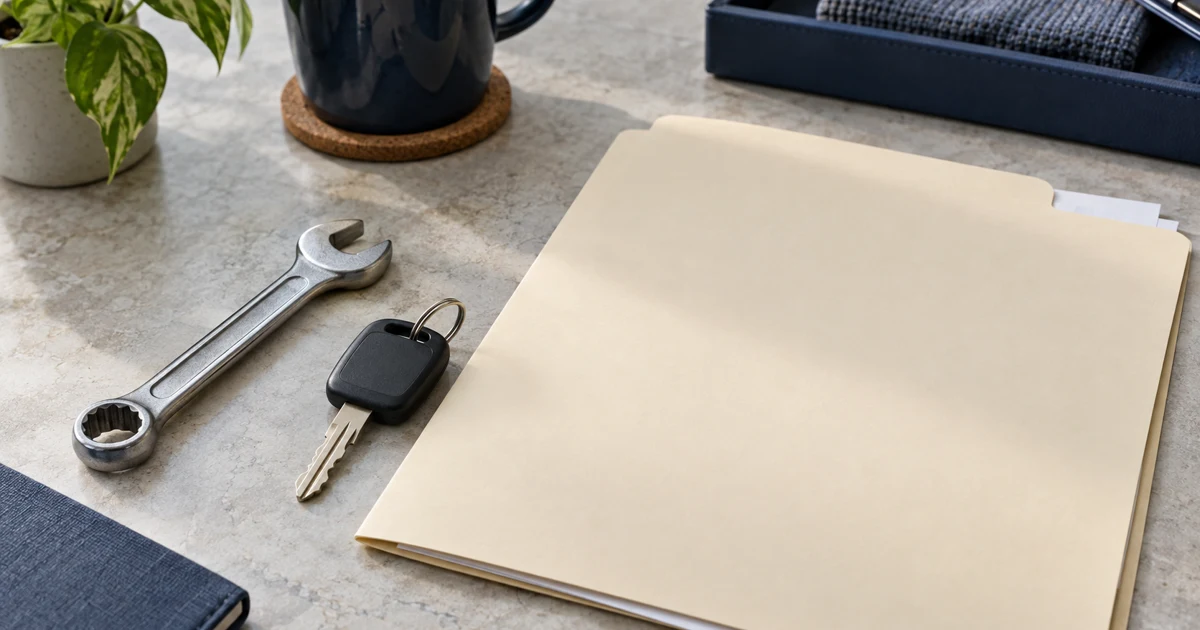
Before leaving your car for repair, request a written estimate or document what you authorise. When the vehicle stays at the garage, keep the deposit receipt or signed estimate serving that purpose. These documents allow later checks of what was commissioned, its price and the expected handover date.
Spain's Royal Decree 1457/1986 governs estimates, deposits, invoices and repair warranties. This guide starts from articles 14 to 16 and the Community of Madrid's consumer information. Regional provisions and vehicle type must be checked where relevant. A rule for a private passenger car is not presented as automatically resolving the repair of every industrial vehicle.
The aim is not to decide from outside which part a mechanic should have replaced. It is to prepare a file distinguishing authorised work, additions during repair and a later problem with the repaired item.
What the estimate must contain
Article 14 recognises the right to a written estimate valid for at least twelve business days. It must identify the garage and user, the vehicle's make, model, registration and mileage, the planned work and parts, and the itemised total price. It also includes the provider's date and signature, expected handover date, validity period and space for acceptance.
An oral price indication is not the same as an estimate identifying work and parts. If an approximate amount is offered because diagnosis is still needed, clarify which task is authorised first and whether preparing the estimate will cost money. Madrid's consumer information recalls that this cost must be communicated and documented where charged.
If you reject the estimate, the royal decree provides for return of the vehicle in conditions similar to those in which it was delivered before preparation of the estimate. This does not mean every diagnosis is necessarily free or may be commissioned without clarifying the financial terms.
Waiving an estimate does not authorise unlimited spending
The service requires agreement by signing the estimate or verifiably waiving its preparation, under article 14.5. If you waive it, keep evidence of what you commissioned and the agreed terms. Absence of an estimate may later make the scope and price harder to reconstruct.
Avoid signing blank spaces that could be interpreted differently from the conversation. If the assignment is only to investigate a vibration or prepare a diagnosis, specify that limit. Clear communication protects the relationship with the garage and reduces later disputes about whether a complete replacement was already authorised.
Waiver does not remove the specific rule for hidden faults discovered during repair. That situation is regulated separately and should not be covered by a general assertion that the garage could do whatever was necessary without limits.
What happens if new faults appear
Article 14.6 requires the user to be informed of hidden faults or defects appearing during repair within a maximum of forty-eight hours, stating their cost. They may only be repaired with the user's express agreement.
Ask the garage to identify the new problem, proposed work, parts and price. If you authorise it through a message or another recordable channel, keep the full conversation. The point is not to demand a communication format the law does not impose in every case, but to establish which proposal you received and accepted.
If you decline repair of that fault, ask for this to be recorded clearly. Article 16.6 addresses the effect of declining repair of previously communicated anomalies or hidden faults where the later failure results from them and its documentary conditions are met. This does not release the garage from every defect unrelated to the rejected repair.
The deposit receipt and handover date
A receipt must be supplied when the car stays at the garage for an estimate or repair. An estimate signed by garage and user can serve as the receipt. The document must state the reason for deposit, identify the vehicle and include the details and expected date required by article 14.
Check that the mileage and registration are correct and that the purpose is clear: diagnosis, estimate or authorised repair. Keep any photographs you consider necessary of its condition on delivery, without confusing them with complete technical evidence of mechanical operation.
The expected handover date helps track the assignment. If it changes, request the reason and revised forecast. Not every delay automatically establishes an additional fault or defective repair, but its effects and the communications should be documented.
When storage charges may apply
Article 15 links these charges to completion of the estimate or repair and notification to the user. If the user does not respond to the estimate or collect the car within three business days, charges may accrue for days exceeding that period while the garage keeps the vehicle on its premises.
The car's arrival alone therefore does not automatically start those charges. What matters is when readiness of the estimate or completion of repair was notified, the response and the days the vehicle remained. Request a breakdown if the invoice includes storage.
Do not ignore a collection notice because you dispute another item. Replying and recording the issue helps separate the questions. A dispute over delivery or payment needs specific analysis; do not assume a protest cancels every future cost.
What the invoice should allow you to check
The invoice must itemise charges, operations, parts and working hours, with an amount for each item. Compare it with the estimate and authorised additions. If there is a difference, ask what explains it and when it was accepted.
The Community of Madrid's information also recalls provision of written information on operations and replaced parts, including repairs covered by warranty. Proof of payment does not itself replace an invoice showing what was done.
Keep the estimate, authorisations, invoice and receipts together. The full sequence is more useful than an isolated photograph of the total. If requesting replaced parts back, check the applicable rules and agreement rather than assuming the same answer for every part or situation.
Is the warranty three months or two thousand kilometres?
Article 16 sets a limit of three months or two thousand kilometres travelled for ordinary repairs, counted from handover. These are not two warranties freely selectable to extend coverage: both limits must be considered. Where parts have a longer warranty, that longer period applies to them.
The rule differs for industrial vehicles: fifteen days or two thousand kilometres, subject to the specified qualifications. This guide focuses on a private car; that difference is precisely why the summary should not be extended to all vehicles without checking their category.
The repair warranty covers materials, labour and the expenses listed in the article. It does not mean every new fault is covered: whether it concerns the repaired part and meets the provision's conditions must be examined. If a problem arises, notify the warranting garage and request instructions before a third party intervenes, because third-party alteration or repair can affect the statutory warranty.
How to dispute a particular discrepancy
Describe the problem with dates, mileage and symptoms, distinguishing observations from a technical conclusion. Attach the assignment documents and request a specific response: explanation of a charge, inspection of the repaired part or action under warranty, as appropriate.
Madrid's consumer information mentions complaint forms and its channels. Before using an administrative or judicial route, check the procedure and deadlines applicable in your region. This guide does not turn a complaint form into automatic compensation or a substitute for proof of damage.
The concept of consumer and user helps establish whether the assignment falls outside professional activity. The burden of proof will matter if the dispute reaches proceedings: preserving documents helps prove facts but does not itself determine the outcome.
Sources
- Royal Decree 1457/1986, articles 14, 15 and 16. Informational consolidated BOE text accessed on 19 November 2026.
- Community of Madrid. Vehicle repair garages, consumer information dated 16 September 2026, accessed on 19 November 2026. Regional routes refer to Madrid and are not presented as a single procedure for all Spain.