Spanish notaries approve their AI deontological code: human supervision and confidentiality as red lines
The code, approved in La Palma, makes human supervision the fundamental criterion and addresses privacy, document fraud and appearance by videoconference. Alfonso Cavallé, of the Council's Permanent Commission, explains it in Cinco Días.
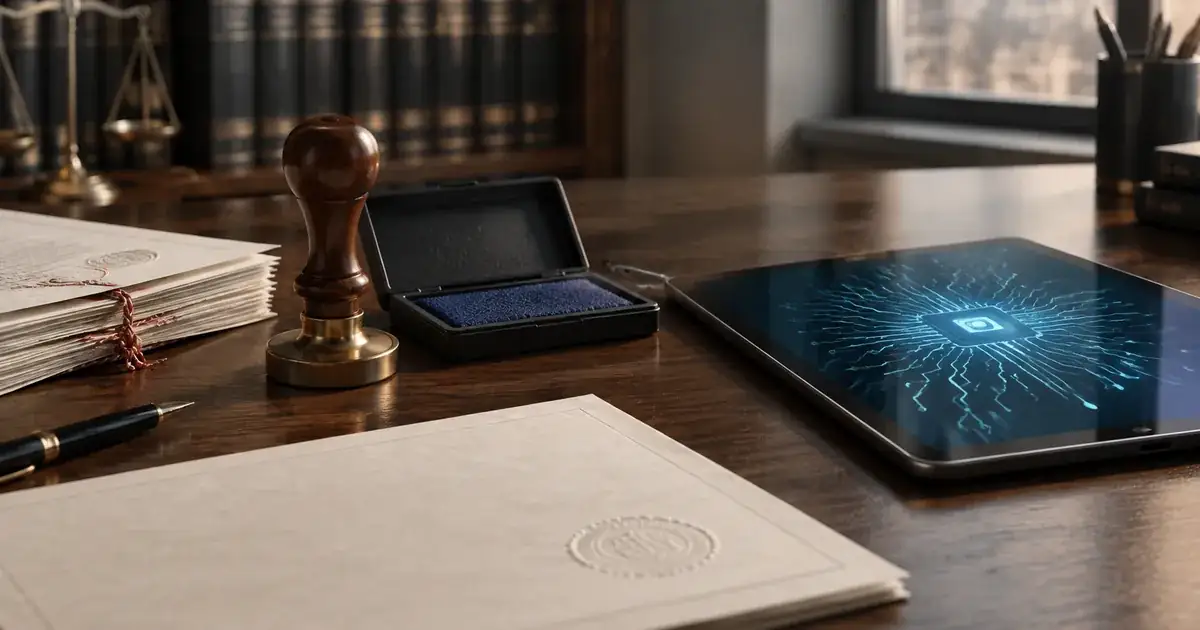
Spain's General Council of Notaries approved on 19 September, in La Palma, the deontological code on notaries' use of artificial intelligence, as explained by Alfonso Cavallé Cruz, member of the Council's Permanent Commission, in an article published by Cinco Días on 19 October.
The code establishes guidelines to guarantee maximum security and trust in the use of AI without compromising the legal certainty, confidentiality and responsibility demanded by the notarial function. It is, to our knowledge, one of the first deontological codes of a Spanish legal profession devoted entirely to AI.
What the code establishes
According to Cavallé's article, the text addresses the major principles that should guide the use of AI in the notary's office:
- Human supervision as the fundamental criterion: no technological result should be accepted automatically when it affects advice, legality or people's rights.
- Professional responsibility, transparency and traceability in the use of the systems.
- Confidentiality, data protection and data minimisation, with special attention to professional secrecy: a notary's office learns circumstances belonging to people's most intimate sphere.
- Prudence in the selection of tools, which must offer sufficient guarantees of confidentiality and security.
- The notary must know the possibilities and limitations of the systems they use.
The article reserves the essential functions for the person: immediacy, the judgment of capacity, balanced and personalised advice, legality control and the investigation of the grantors' true will. "Trust cannot be automated," Cavallé summarises.
The risks the code aims to prevent
The Cinco Días piece also details the concrete dangers behind the deontological rule:
- The mass processing of personal data and the possible uncritical automation of legal decisions.
- The appearance of truth in error: when the algorithm is wrong, it can be so with an appearance of accuracy, without considering the particulars of the case.
- AI-powered document fraud: convincingly realistic images, voices, signatures and documents, including apparently official seals or QR codes linking to pages that imitate public institutions.
- Appearance by videoconference, which requires extreme caution to verify identity and freedom of will against impersonation with artificial images or voices.
A code that transcends the profession
Cavallé underlines that the approval of the code "transcends the internal organisation of a legal profession and directly affects citizens' trust in the institution and in the security of their legal relations". The notarial response, he explains, is not to renounce digitalisation but to accompany it with guarantees: notarial public faith, which guarantees the authenticity and security of legal acts, must adapt to the new media without losing its essence.
Why it matters for the legal profession
The notaries' move comes after the General Council of the Spanish Legal Profession presented its White Paper on Artificial Intelligence and the Legal Profession in January, and after the CGPJ's Instruction 2/2026 on judges' and magistrates' use of AI, which sets the principle of effective human control. The three texts share the same central idea: AI as a tool at the service of the professional function, never the other way around. We cover these rules and their practical application in our Legal AI section, with guides such as the AI Regulation for high-risk cases.
It also has an immediate disciplinary reading: courts are already fining lawyers who file briefs with AI-invented citations, as we report today in Fines for AI hallucinations are already reaching the courts.
The idea inspiring the code, in Cavallé's own words, is that "the greater the power of technology, the greater the ethical demand on those who use it". A maxim the legal profession would do well to borrow.
Fuentes
- Artificial intelligence enters the notary's office (Cinco Días, El País). Accessed 20 October 2026.
The specific data in this article come from the official sources cited.