Three fines in one year for AI hallucinations in appeals: case law now punishes fake citations
420 euros in February in the Canary Islands for 48 fake rulings, 1,800 in July in Galicia for 24 invented citations - with referral to the bar association - and 840 in August again in the Canary Islands for 25 fake or distorted decisions. The Galician court relied on the profession's AI White Paper and the CGPJ's Instruction 2/2026.
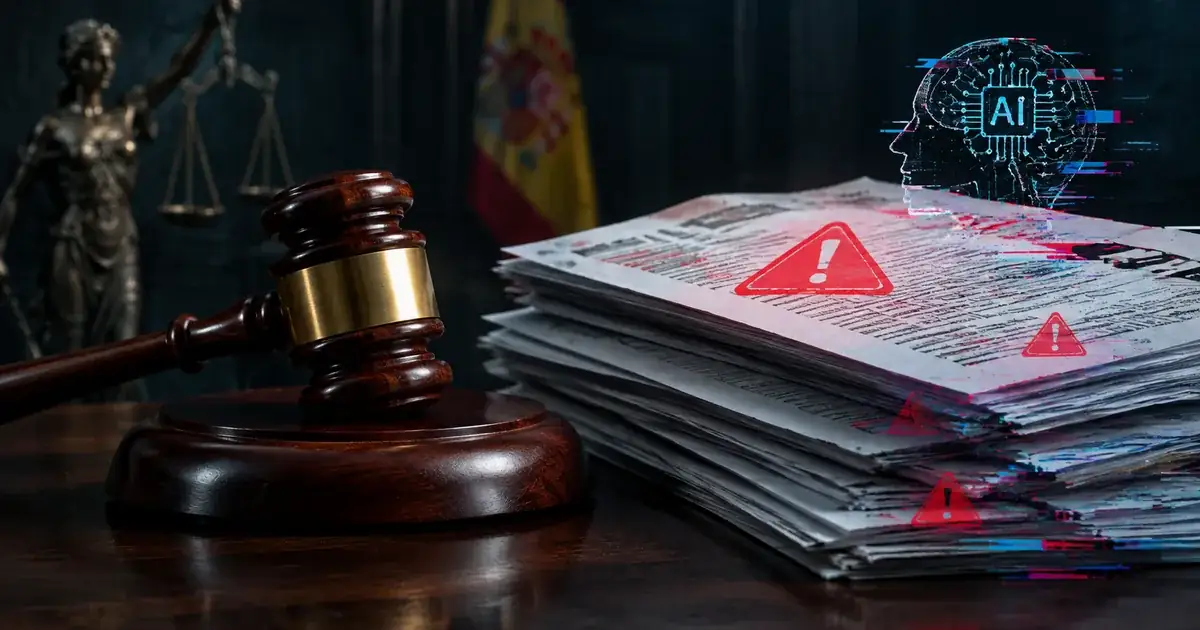
Spanish courts no longer just warn about artificial intelligence hallucinations: they sanction them. So far this year, three lawyers have been fined for filing appeals with rulings invented or distorted by AI systems, as compiled by legal communications consultant Laura Celeste Sali in an op-ed published by Expansión Jurídico on 19 October.
The three cases, in detail:
- February 2026, High Court of the Canary Islands (TSJ): a 420-euro fine for a lawyer who filed an appeal with 48 fake rulings generated by artificial intelligence.
- July 2026, High Court of Galicia (TSXG): a 1,800-euro fine for another lawyer over an appeal with 24 invented case-law citations. The court also referred the case to the A Coruña Bar Association.
- August 2026, High Court of the Canary Islands: a new sanction, this time 840 euros, for a third lawyer over at least 25 fake or distorted judicial decisions in another appeal.
What the courts rely on
The Galician court grounded its sanction on two texts: the White Paper on Artificial Intelligence and the Legal Profession, presented by the General Council of the Spanish Legal Profession in January, and Instruction 2/2026 of the CGPJ plenary, which regulates judges' and magistrates' use of AI and sets the principle of effective human control.
The Galician court's conclusion marks the line that is already standard: a lawyer may rely on these systems to prepare or study the case, but not to draft the procedural brief without verifying what they produce. AI as a work tool, yes; AI as an unsupervised drafter, with a fine and disciplinary risk.
The problem that never reaches the courts
Sali's op-ed focuses on the other side of the phenomenon: those three cases reached a court and someone detected them, but much of the AI-generated legal information circulates unfiltered among citizens. In Spain, the share of people using ChatGPT frequently rose from 4% in 2023 to 28% in 2025, according to the III Funcas Survey on Artificial Intelligence cited in the article. A growing share of those queries seeks guidance on a dismissal, an inheritance or a contract.
Language models, the author recalls, do not consult a verified legal database: they generate text by statistical prediction, and when the available material on a subject is scarce or low-quality, they fill the gaps with plausible but incorrect inferences. Spanish courts themselves have already named that phenomenon in their rulings: hallucination.
The response is also the profession's
The op-ed's thesis is that the legal profession has more room than it thinks: generative systems learn from what is published and cited online, so every rigorous analysis a lawyer publishes improves the base the model draws from. It is the same idea that guides our Legal AI section, where we measure which assistants fail least in the Observatorio Legal ranking of legal reliability of AI and explain how to comply in the practical guide to the AI Regulation for high-risk cases.
For a law firm, the operational lesson is threefold: always verify citations before signing (the fine and the referral to the bar are already real), train the team on these tools' limits and set a written internal use policy. Effective human supervision is also the central criterion of the notaries' new AI deontological code, which we cover today in Notaries approve their AI deontological code. And it is consistent with our editorial standard, explained in How we verify information at Agente Lex.
Fuentes
- If the legal profession does not publish, AI answers for it (Expansión Jurídico, op-ed by Laura Celeste Sali). Accessed 20 October 2026.
The specific data in this article come from the official sources cited.