Per diems and mileage for the self-employed lawyer: what is deductible, in what amounts and under which requirements
Confusing the employee regime with the self-employed one is the most frequent source of errors in the tax return. We clarify it with the regulation in hand.
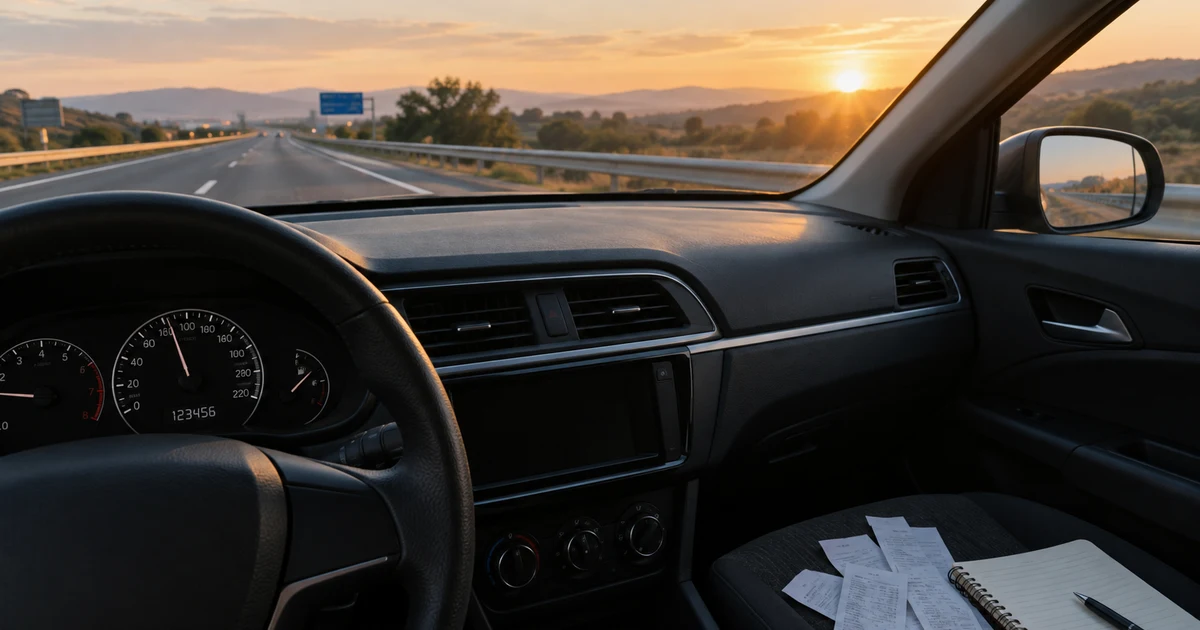
A self-employed lawyer who visits a client in another city asks the same question every quarter: can I deduct the trip the way an employee would? The short answer is no, not in the same way. The per diem and mileage regime has two distinct worlds in Spanish personal income tax, and mixing them is one of the most frequent sources of errors and of requests from the Tax Agency.
What does NOT apply to the self-employed: the 0.26-euro mileage rate
The 0.26 euros per kilometre amount exempt from taxation, set in article 9 of the Income Tax Regulation approved by Royal Decree 439/2007, is a regime designed for employment income: it compensates the employee who uses their own vehicle for work reasons. The self-employed lawyer is not taxed on employment income but on economic activities, and therefore has no exempt "price per kilometre" to apply.
What they can do is deduct the real expenses of the vehicle allocated to the activity: fuel, maintenance, insurance, depreciation and taxes. Here lies the real practical difficulty: allocation. Passenger cars with mixed use generate constant litigation, because the Administration requires proof of exclusive allocation to admit full deduction in income tax, while in VAT the law presumes a 50 % allocation for cars with professional use, unless proven otherwise. Mixed-use vehicles and those intended for transport receive more favourable treatment.
The practical conclusion: a travel log (date, purpose, client, kilometres) and fuel invoices linked to the activity are the best defence in an inspection.
What IS deductible: subsistence with limits and requirements
Since the 2018 reform, article 30.2 of the Income Tax Law allows the self-employed under direct estimation to deduct the subsistence expenses they charge to themselves on professional trips, with these limits: 26.67 euros per day in Spain and 48.08 euros abroad when there is no overnight stay, and 53.34 euros in Spain and 91.35 euros abroad when the trip includes an overnight stay.
The requirements are strict and all must be met at once:
- The expense must be incurred in restaurants and hospitality establishments.
- It must be paid by electronic means (card, transfer, cheque): cash payment voids the deduction.
- The full invoice must be kept, not the receipt.
- There must be a correlation between the day, the place of the expense and the professional activity.
And the firm's employees
For lawyers and staff employed by the firm, the amounts exempted from taxation under article 9 of the Regulation do apply: 0.26 euros per kilometre for travel in one's own vehicle, 53.34 euros per day of subsistence in Spain without overnight stay and 91.35 euros with overnight stay, with accommodation expenses fully justified. Whatever exceeds those amounts is taxed as employment income.
Frequent errors worth avoiding
- Applying the 0.26-euro mileage rate in the self-employed person's accounts: that concept does not exist in economic activities.
- Deducting meals paid in cash or with a receipt: without an invoice and electronic payment there is no deduction.
- Deducting 100 % of a mixed-use car without proof of exclusive allocation.
- Not keeping the justification of the trip: without a link to the activity, the expense is private.
Integration with the firm's wider tax picture
Per diems and travel are just one piece of the deductible expenses chapter. For the whole simplified direct estimation system we recommend our guide to deductible expenses in simplified direct estimation, and for the treatment of home-office utilities, the analysis of utilities of the self-employed lawyer's home. In the quarterly return, these expenses reduce the income carried to form 130.
As always in tax matters, the amounts in force should be confirmed each year in the consolidated text of the regulation: the Income Tax Regulation is updated frequently. In our Solo practitioners section we follow every change closely.
Fuentes
- Royal Decree 439/2007 approving the Personal Income Tax Regulation, article 9 (consolidated text) (BOE). Accessed 22 October 2026.
- Law 35/2006 on Personal Income Tax, article 30 (consolidated text) (BOE). Accessed 22 October 2026.
The specific data in this article come from the official sources cited.