Verifactu for self-employed lawyers: the 2027 deadlines and what to do about your invoicing software
Royal Decree-law 15/2025 delayed by a year the obligation to adapt invoicing software to the regulation known as Verifactu. For a lawyer who practises on their own, the key date is 1 July 2027. We explain who is obliged and how to prepare.
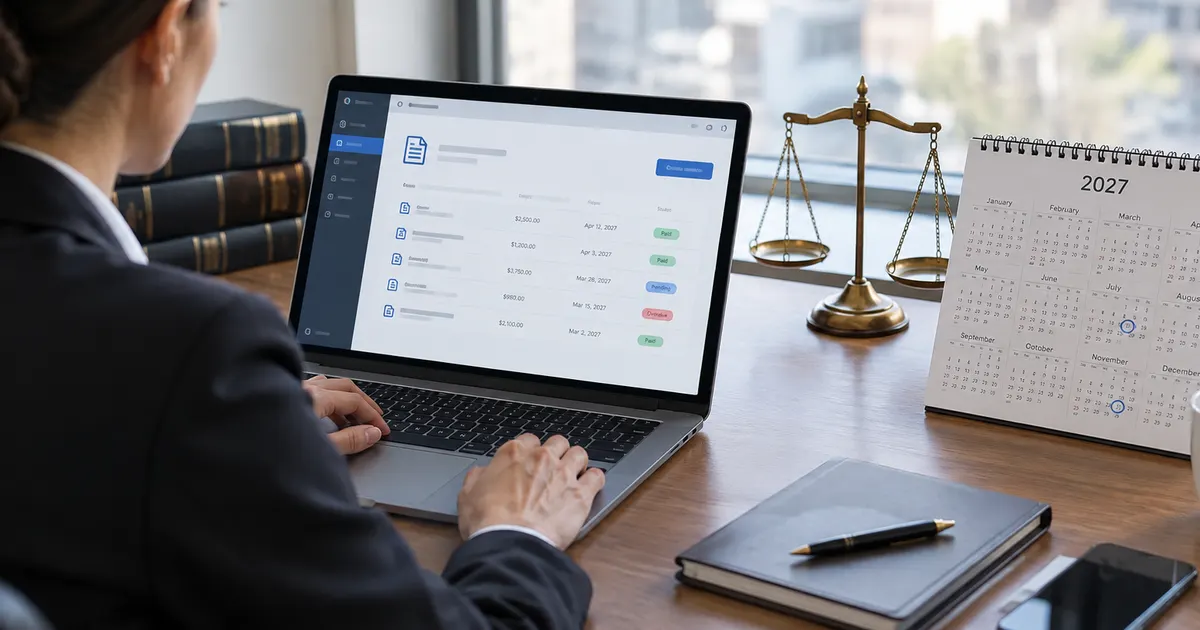
The regulation that sets the requirements for computerised invoicing systems, approved by Royal Decree 1007/2023 and known by the name of one of its modes, Verifactu, was due to become mandatory in 2026. It will not. Royal Decree-law 15/2025 of 2 December extended the adaptation period, and Congress validated it, according to the resolution of 11 December 2025 published in the BOE.
For a lawyer who practises on their own account, that leaves a wide margin, but not an indefinite one.
The new dates
According to the Tax Agency's information note:
- Corporate Income Tax taxpayers must have their invoicing systems adapted before 1 January 2027.
- All other taxpayers must do so before 1 July 2027.
An individual lawyer who pays personal income tax on their activity therefore falls into the second group. If they practise through a professional company, the relevant date for that company is the first one.
Until those dates, the Tax Agency allows non-adapted systems to continue to be used and allows test records to stop being sent in the Verifactu mode.
Who is obliged?
The Tax Agency summarises the scope in what it calls the four "no" rule. The obliged parties are businesses and professionals established in Spain who issue invoices and who:
- Do not invoice only by hand.
- Are not on the Immediate Supply of Information (SII), whether compulsorily or voluntarily.
- Do not have their tax domicile in the foral territories of the Basque Country or in Navarre.
- Do not have a non-application decision in force.
Self-employed lawyers who are not on the SII will meet all four requirements if they invoice with a program.
Invoicing by hand, in Word or in Excel
The Tax Agency's frequently asked questions clarify two situations that can arise in small firms:
- Manual invoicing. Anyone who issues invoices by hand is not affected, because they do not use any computerised invoicing system. A computer system cannot be combined with manual invoices in the same invoicing.
- Word processors and spreadsheets. According to the Tax Agency, the regulation does not apply if they are used exclusively to enter data, issue and print invoices and keep the information. But if the tool processes the data to obtain other results, for example a spreadsheet with a macro that generates the register of issued invoices, it is considered a computerised invoicing system and is subject to the rules.
The Tax Agency has also announced a free basic invoicing application as an alternative.
What to do between now and July 2027
1. Identify how you invoice today
Take stock: firm management software, standalone invoicing software, spreadsheet, text template or manual invoice. Whether you have to adapt depends on that.
2. Ask your supplier
If you use firm management software that issues invoices, ask the supplier in writing to confirm whether its version complies with the regulation and in which mode.
3. Decide the mode with your adviser
The Tax Agency refers to the Verifactu mode, in which the system sends the invoicing records. Before choosing how to comply, review with your tax adviser the options the regulation allows and how they affect your day-to-day operations.
4. Tidy up invoicing before the change
Review numbering series, client data and corrective invoices. Reaching 2027 with tidy invoicing makes the system change easier.
5. Do not leave it to the last minute
The 2025 delay shows that the calendar can move, but also that the obligation remains. Adapting in the first half of 2027 leaves time to resolve incidents.
Invoicing and ethics
A clear invoice also helps meet the duties of information to the client. The Organic Law on the Right of Defence recognises the client's right to receive information on costs and fees, and allows a written engagement letter with a quote to be demanded.
This article is informational and does not replace tax advice. More guides for those who practise on their own in Solo and small-firm lawyers, starting with the one on the self-employed contribution for lawyers in 2026. If you are looking for management tools, the Legal Tech Expo 2026 brings together law firm software providers in November.
Fuentes
- Real Decreto-ley 15/2025, de 2 de diciembre (BOE-A-2025-24446). Accessed 18 October 2026.
- Resolución de 11 de diciembre de 2025 del Congreso de los Diputados, convalidación del Real Decreto-ley 15/2025 (BOE-A-2025-25695). Accessed 18 October 2026.
- Agencia Tributaria. Nota informativa sobre la ampliación del plazo de adaptación de los sistemas informáticos de facturación. Accessed 18 October 2026.
- Agencia Tributaria. Preguntas frecuentes sobre el ámbito de aplicación de los SIF. Accessed 18 October 2026.
The specific data in this article come from the official sources cited.


