Cooley and Google develop a Gemini Enterprise agent to redact confidential information from court filings
The agent recommends redactions of personal data, technical information and other potentially confidential material, but the lawyer decides what gets redacted before the filing is submitted. It is still in development.
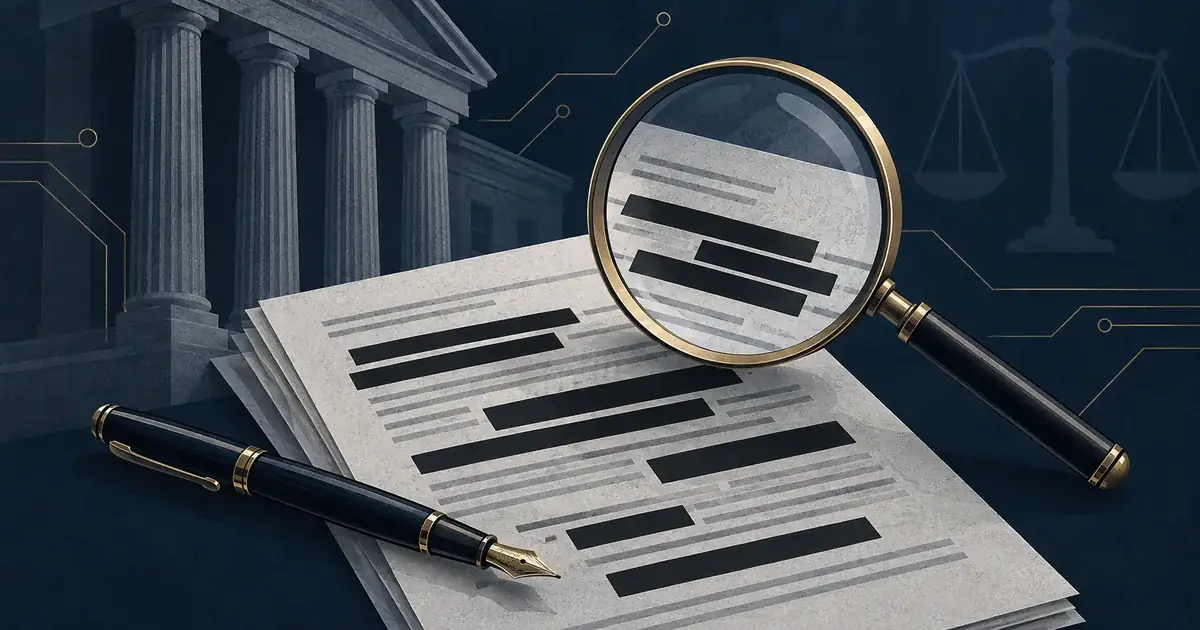
US law firm Cooley has announced a collaboration with Google to develop an AI agent on Gemini Enterprise, Google Cloud's platform, to help lawyers review court filings for confidential information and prepare the proposed redactions. The announcement is dated October 8, 2026 in New York.
Redacting court filings to protect confidential information can consume days of lawyer work reviewing documents and identifying sensitive material, with little margin for error. The agent recommends targeted redactions of personally identifiable information, technical information and other potentially confidential material, but it is the lawyers who decide what gets redacted before the filing is submitted. The tool aims to speed up review while keeping legal judgment with the lawyers on the matter.
Cooley as launch partner
Cooley acts as launch partner: it contributes product direction and continuous feedback from its litigators so the engineers design the flow around the practical demands of complex litigation. The use case was born from real problems in its practice. Ian Shapiro, chair of the global litigation department, recalls that Cooley has collaborated for years with Google as litigation counsel and that it is now developing the AI workflows that will let it litigate more effectively. Satish Thomas, vice president at Google Cloud, stresses that the most effective AI tools are built by validating the technology against real, demanding use cases.
Shapiro completed his assessment: the firm is now developing the AI workflows that will let it litigate for its clients more effectively and efficiently, and that is why it welcomes the chance to collaborate with the Google team. The announcement describes the union as the intersection of an enterprise AI platform and the experience of Cooley's global litigation practice, within a broader approach by the firm: combining legal judgment and industry knowledge with cutting-edge technology, with the lawyer's judgment at the center.
The agent remains in development and is one of several AI workflows and tools the firm is exploring. Cooley has close to 1,400 lawyers in 19 offices across the United States, Asia and Europe.
Why this use case
Confidentiality review is a stretch of litigation with a specific profile: high page volume, repeatable criteria (personal data, technical secrets, sensitive commercial information) and a disproportionate cost of error, because a redaction that fails exposes the client and one too many can clash with the principle of open courts. That profile makes it a natural candidate for supervised automation: the agent proposes and the lawyer disposes. It is the same division of roles defended by AI-native law firms such as Arceus and the signal demanded by the governance market covered by Confide: machines executing, people deciding, everything logged.
That the announcement includes no accuracy metrics is relevant. Without a published error rate, the tool is presented as a review aid and not a substitute, and that is how it should be read until production performance data exists.
Law firms as builders
The announcement represents a different pattern from the makers': here it is a large law firm co-designing the tool with a cloud provider for its own practice. It is the opposite route from the generic platforms, such as the matter coordination layer presented by Harvey with Legal Work Orchestration, and it coexists with the consolidation of litigation software through acquisitions, such as Bundledocs by Opus 2. In all three approaches, the promise is the same: take hours of manual work out of litigation without taking the lawyer's judgment out of the loop.
This story is part of our legaltech startups and AI section, where we track launches, rounds and deals in the sector.
Sources and limits
The collaboration and the quotes appear in the official announcements of Cooley and Google Cloud of October 8, 2026. The agent is in development: there is no general availability date, no pricing and no public metrics on the accuracy or error rate of the proposed redactions, and we do not estimate them.
Fuentes
- Cooley. Cooley Collaborates With Google Cloud to Develop AI Agent for Complex Litigation. Accessed 19 October 2026.
- Google Cloud Press Corner. Cooley Collaborates With Google Cloud to Develop AI Agent for Complex Litigation. Accessed 19 October 2026.
The specific data in this article come from the official sources cited.