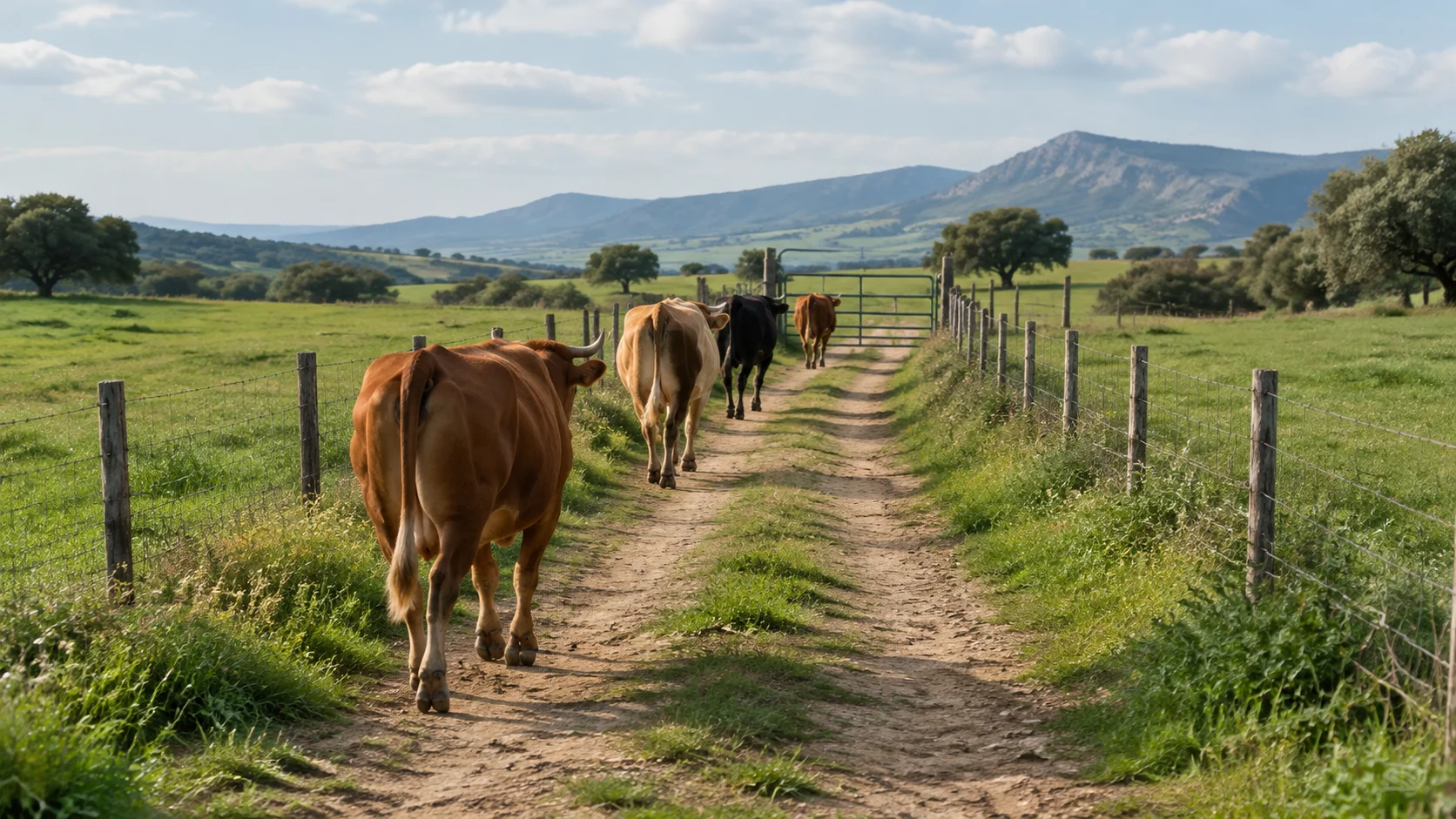
How to recover an occupied livestock trail: the roadmap consolidated by the Rota case
Administrative complaint, demarcation, ex officio recovery and judicial review: the proven route to defend occupied public paths after the Rota case.
The finality of the Rota case, which we analyse in our coverage of the Supreme Court order on the Rota livestock trails, does more than close a Cádiz dispute: it offers law firms, associations and administrations a proven sequence for acting against the occupation of public paths. It is worth taking it apart step by step, because its practical value lies precisely in how replicable it is.
The starting point is statistical and uncomfortable. Nobody knows how much livestock-trail surface is occupied in Spain, but the collectives speak of cases documented for centuries that have intensified over the past twenty years, with particular incidence in Castilla-La Mancha, Extremadura and Andalucía. Behind it lies a simple incentive: occupying a demarcated but unrecovered path costs nothing while the administration looks the other way. The Rota case shows that such inaction is numbered once someone takes it to court.
Preliminary step: knowing whether the path is classified and demarcated
The whole strategy rests on one registry-administrative fact: the formal status of the trail. Ley 3/1995, of 23 March, on Livestock Trails distinguishes classification (the act recognizing the trail's status and type: cañadas of up to 75 meters, cordeles of up to 37.5 and veredas of up to 20, under its article 4) from demarcation, which article 8.1 defines as "the administrative act by which the boundaries of livestock trails are defined in accordance with the classification act".
Rota was the most favorable scenario: trails classified and demarcated in 2005 and 2006, with later occupation duly proven. There, the demarcation file already included "necessarily the list of occupations, intrusions and adjoining properties" (art. 8.2), so the administration had documentary knowledge of every encroachment. Where no demarcation exists, the procedural path is longer: demarcation must first be sought, a procedure with a hearing for neighboring owners that can take years, but with one decisive virtue: once approved, it "declares possession and public-domain ownership in favor of the Autonomous Community" and contradictory registry entries cannot prevail against it (art. 8.3).
First phase: the documented administrative complaint
The Rota association did in December 2020 what every practice manual recommends: a formal complaint, in writing and with proof of receipt, addressed to the Junta de Andalucía, identifying the trails, their demarcation and the specific occupations. That filing serves three functions. It fixes the date from which the administration is under a duty to act. It evidences the claimant entity's interest. And it turns subsequent inactivity into a documented fact, not an impression.
It pays to be thorough here: attach the classification decision, the demarcation order, georeferenced photographs of the occupations and, if possible, the list of intrusions from the demarcation file itself. The tighter the factual picture, the less room the administration will have to respond with silence or boilerplate.
Second phase: inaction as the object of the litigation
If the administration does not act, the open channel is the judicial-review jurisdiction, and the Rota case shows its usefulness. The claim did not ask the judge to evict anyone; it asked that the administration be ordered to fulfil its duty: to "open, process and decide the ex officio recovery procedures". It is a procedurally modest and materially forceful claim, because the judge does not replace the administration but removes its option of doing nothing.
The final judgment adds two corollaries of great litigating value. The first: recovery is not "a discretionary power", so the court can review the omission without intruding into the administration's margin of appreciation; what it reviews is the breach of a rule, ground on which judicial control is full. The second: a lack of "technical and material means" does not justify the absence of a response. With these two points, the habitual defenses of respondent administrations are sharply reduced.
Public-domain nature as a shield against the passage of time
The question every neighboring owner asks their lawyer is whether the passing years give them any right. The answer is in article 2 of Ley 3/1995: "Livestock trails are public-domain assets of the Autonomous Communities and, consequently, inalienable, imprescriptible and unseizable". Public-domain imprescriptibility is absolute: no adverse possession is possible, not even after fifty years of continuous good-faith farming.
There is, however, a specific and narrow limitation period: article 8.6 sets five years from the approval of the demarcation for civil actions over rights relating to land included in the demarcated public domain. That is the window available to affected parties to defend titles they believe contradict the demarcation; once it lapses, public ownership is consolidated. And the occupant's liability does not end with returning the land: article 20 obliges them to repair the damage with the aim of restoring the trail "to the being and state prior to the commission of the aggression", and criminal liability is even possible in the cases covered by article 23.
The occupant's side: what to advise when the client built the fence
A practical guide must also look at the other side of the table. The owner who occupies part of a demarcated trail must be told the full truth: their position does not improve with time, improvements or harvests, and enforcement can arrive decades later with costs and reparation at their expense. The reasonable strategy involves checking whether their property has a registry-based case against the demarcation within the article 8.6 period, negotiating where possible (the COAG farming organization has proposed making livestock or recreational uses compatible with farming use on payment of a fee) and, in any event, not aggravating the occupation: new intrusions generate additional administrative liability for infringements that, depending on their gravity, prescribe in periods of one to five years (art. 24).
The cost of not claiming in time
There is an economic argument that is often overlooked: while the trail remains occupied, deterioration accumulates and restoration becomes more expensive. Article 20 sets the goal of returning the trail "to its prior being and state", which in practice may involve replanting trees, removing infrastructure or recovering eroded margins, all at the infringer's expense. The sooner the situation is documented and claimed, the smaller that balance and the easier the proof of the original state. Early complaint, besides being a civic duty, is an evidentiary strategy.
What this pattern suggests for other administrations
The public-management reading is perhaps the most important. If a lack of means does not excuse omission, the only sustainable policy is planning: an inventory of classified but undemarcated trails, a demarcation calendar and a budgeted, staggered recovery program. The alternative, already demonstrated in Rota, is that a judicial-review court ends up setting the agenda instead of the competent department, with the institutional wear and procedural cost that entails.
There is also an asset that administrations should not waste: public use. The collectives recall that around 7.5 million people go hiking in Spain, and that livestock trails underpin rural tourism and ecological connectivity between farms and villages. Recovering them is not just complying with the law: it is recovering free public infrastructure. More context in our procesos y litigios section, in the analysis of Inspección de Trabajo transparency after complaints are shelved and in the vía pecuaria entry of our dictionary.
FAQ
What should an association do about an occupied public path? Check whether the trail is classified and demarcated, file a documented administrative complaint with the demarcation and occupations evidenced and, if met with inaction, go to the judicial-review jurisdiction asking that the administration be ordered to open, process and decide the recovery procedures.
How long does an occupation of a livestock trail take to prescribe? Never: livestock trails are imprescriptible because of their public-domain status (art. 2 of Ley 3/1995). Only civil actions by affected parties against the demarcation prescribe five years after its approval (art. 8.6).
What can the administration claim from the occupant? Return of the land and repair of the damage caused, with the aim of restoring the trail to its state prior to the aggression (art. 20), in addition to any applicable administrative sanctions and, where appropriate, criminal liability.
Sources
- Ley 3/1995, of 23 March, on Livestock Trails (BOE-A-1995-7241, consolidated text), consulted 13 November 2026.
- El Periódico / Agencia Efe, "Importante sentencia del Supremo sobre caminos públicos" (12 November 2026), consulted 13 November 2026.
- El País, "El Supremo marca la senda para recuperar miles de vías pecuarias usurpadas por los agricultores" (4 November 2026), consulted 13 November 2026.
Fuentes
- Source. Accessed 13 November 2026.
- Source. Accessed 13 November 2026.
- Source. Accessed 13 November 2026.
The specific data in this article come from the official sources cited.